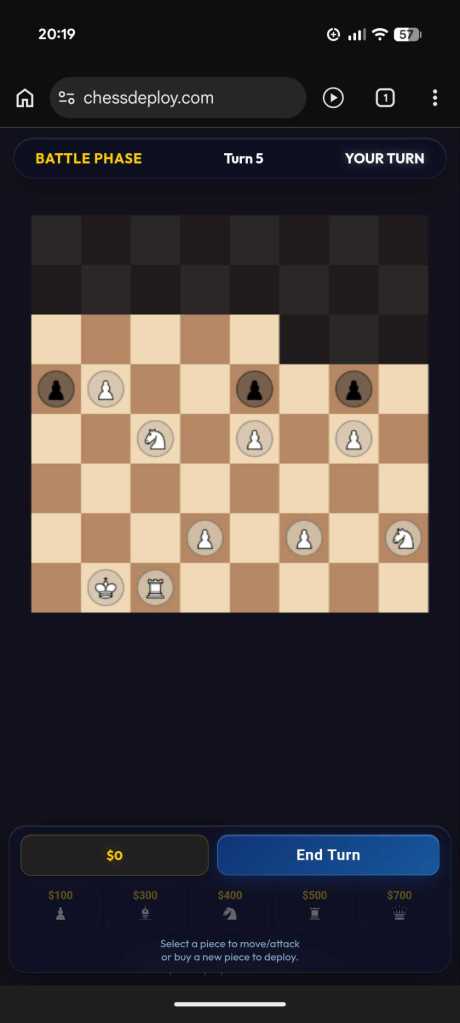
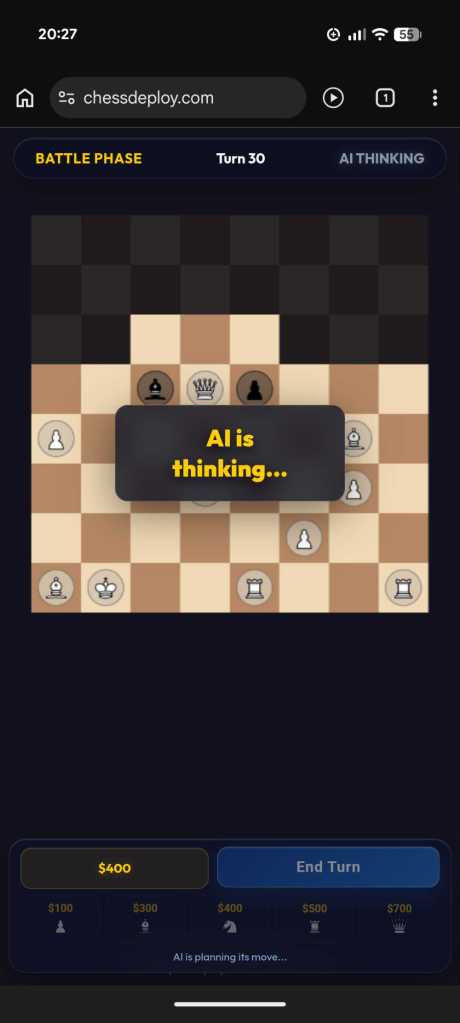
I developed a full game just complety from zero and entirely with my Hermes Agent and through my phone using Telegram! The whole development took me around 3 weeks, with the first two mainly focusing in building the dynamics and the UI while the third one has been on making sure that the AI is good enough to this twist (I got inspired by AlphaGo and went full Reinforcement Learning mode)! All in all with only spending $10 on buying the domain.
See below more details of the technicalities behind this setup. You can use it to replicate a similar tech stack!
When deploying highly reactive strategy games to the web, conventional architecture dictates utilizing an authoritative server to manage secret variables, state verification, and artificial intelligence lookup trees. For ChessDeploy.com, the design goal was to completely flip this paradigm: establishing a zero-backend architecture that shifts 100% of the computational, graphical, and algorithmic execution directly to the user’s browser.
Client-Side Security & State Protection
Building a multiplayer game with hidden elements (like a Fog of War mechanic) entirely within a web browser introduces a unique security hurdle: front-end inspection. Since the entire state matrix lives in the client’s local memory, a developer could easily peek into the data structures to find hidden opponents.
To counter this without a dedicated server, the architecture relies on strict compilation pipeline obfuscation. During production bundling, codebases are systematically transformed into abstract structures, variable naming patterns are flattened, and literal strings are converted into encrypted, rotational arrays. This ensures that while the browser engine retains access to pathfinding coordinates, the raw state remains completely shielded from casual execution manipulation or runtime console hacking.
The Automated Mirroring Pipeline
To keep development history completely separated from the live public-facing code, the project utilizes an automated repository mirroring pipeline powered by continuous integration workflows.
When changes are pushed to the main codebase, a cloud runner acts as a headless compiler. It runs static type-checks, minifies assets, and then clones an entirely separate, public distribution repository. The pipeline carefully runs a directory-clearing operation that flushes out out-of-date static build files while keeping crucial version tracking parameters intact. Finally, it writes the custom apex domain records directly into the build workspace and deploys everything securely to public web-hosting nodes.
The Dual-Engine AI Framework
The game’s artificial intelligence functions through a hybrid framework that scales computationally based on the player’s chosen difficulty.
Layer 1: Positional Lookahead Minimax
For basic tactical play, the AI executes an optimized heuristic Minimax search. Because full board visibility is obscured by the fog of war, the engine generates an internal positional advantage heat matrix. It analyzes immediate risks, assigning high penalties to valuable units moving into threatened zones, while rewarding solid pawn defense chains and spatial dominance across center rows.
Layer 2: Convolutional Neural Network (CNN) Inference
On the highest difficulty, the engine introduces machine learning by executing deep learning models natively in the browser via an optimized ONNX runtime environment.
The system maps the live board layout into a multidimensional spatial tensor grid comprised of 8 analytical channels:
- Material Channels: Map unit types and positions belonging to each faction.
- Vision Matrix: Evaluates real-time visual boundaries under active fog constraints.
- Threat Mapping: Quantifies global offensive pressure and line-of-sight vectors across all tiles.
- Match Progress Trackers: Monitor current gold balances, asset values, and timeline velocity.
Instead of outputting hardcoded movements, the convolutional neural network runs local forward inference to evaluate which overall playstyle profile has the highest statistical probability of success given the current board arrangement. The model outputs a strategic profile index, which instantly alters the downstream minimax behavior—dynamically morphing the AI from a defensive turtle to an ultra-aggressive attacker in real time.
Zero-Asset Procedural Audio
To maintain sub-second page load times, the game bypasses asset loading for its audio design entirely. Rather than streaming large background music tracks or audio sprite files over the network, a procedural synthesizer script interfaces directly with the browser’s hardware audio framework.
Using mathematical wave generation, it programmatically layers lowpass-filtered bass lines, white-noise percussion envelopes, and microtonal arpeggios on the fly. Game event hooks (such as captures, checks, or status transitions) pass real-time parameters directly to frequency modulators, creating a responsive soundscape with zero network bandwidth footprint and absolute zero operational costs.
Below some images of the game and head to play the game in ChessDeploy.com